

Dreamlover
Trends are no longer, uh, trendy

I’ve just spent twenty minutes trying to find where I was chatting with reader George Henderson late last year about the idea of ‘gauche’.
Back in April, I revealed that I had abandoned a piece of work about the idea of gaucheness in music, this idea that - in a race to be noticed - artists are increasingly relying on a lack of subtlety, a lack of social norms or social acceptability, to stand out from their peers.
As a descriptor, gauche usually refers to awkwardness - Google gives an example of asking an intrusive personal question at a formal dinner and making things awkward. It can be applied to people who are just awkward people; I’ve often made a point of asking awkward questions at meetings.
The point of the discussion I was having with George was that you can wield gaucheness as a weapon. Make it a feature, not a bug, to use modern parlance.
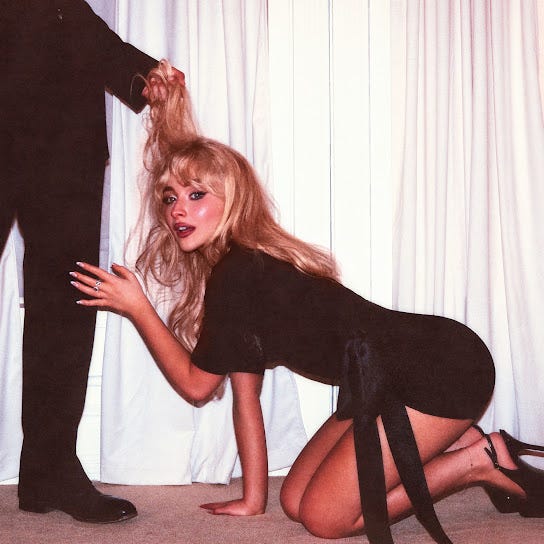
The cover of Sabrina Carpenter’s 2025 hit album Man’s Best Friend is a perfect example, a major artist embracing trashiness as a way to attract eyeballs and media coverage; the response to the cover photo of Carpenter on all fours in front of a man pulling her hair - the response was as much the point, if not more.
I was thinking about gaucheness again this week when I saw a post on Reddit posing a simple question: What are the current trends in music? The Reddit community had made a number of suggestions including:
“Making fun of Drakes newest releases”
“Everything just feels like a remix of a remix”
“The best genre right now is hating the British government”
“Mongolian shoegaze”
“Music is better now than at any point in human history”
“AI-driven ear slop. It's why everything sounds so low-effort.”
“I truly believe enunciation will make a comeback.”
“Shit and more shit.”
Numerous mentions of Angine De Poitrine and Geese
Not a single mention of gaucheness. For shame.
(Though I might have to look into this “Mongolian shoegaze” a bit more.)
If you’ve been reading Ephemeral for a while, you’ll know I primarily love rock and metal music, bands like Deftones and Sleep Token and Callous Daoboys and Turnstile. I recently bought Sepultura’s Roots on vinyl. I’ve been on a Tool binge for the last week, especially their 2001 record Lateralus.
However, my first conscious album purchasing decision came back in 1993 when I was a mere 12 years old and nearing the end of Form 2 (Year 8).
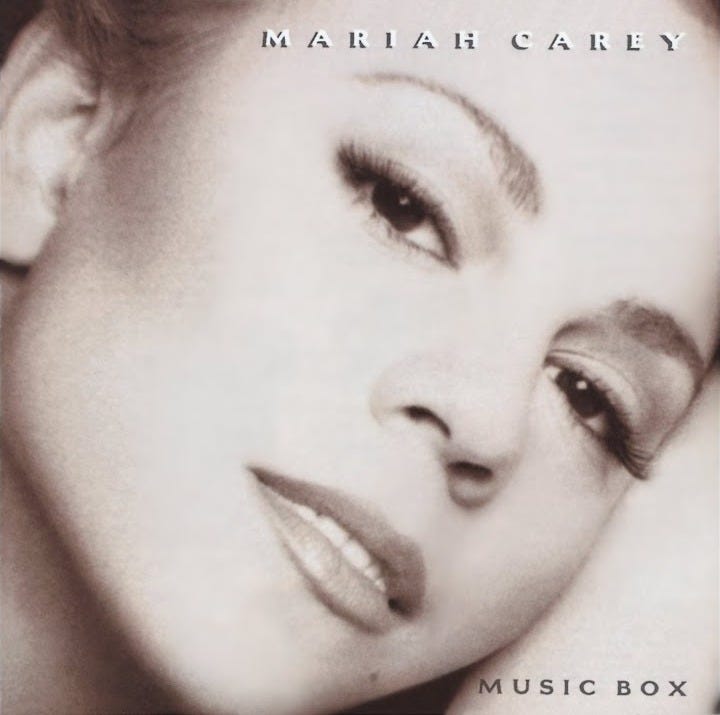
It was Mariah Carey’s Music Box on cassette.
Back in 1993, I was still discovering my taste in music. I had somehow come into possession of a couple of tapes - MC Hammer’s Please Hammer Don’t Hurt ‘Em and Michael Jackson’s Bad among them - and I had a compilation called Check This Out 4 with cuts from UB40, Roxette and Enigma. It was a weird time.
Mariah Carey was huge at the time, the next big thing in pop music, following the release of “Hero” and a string of hit singles. Music Box is Carey’s third album and her first foray into the pop-R&B sound that would make her famous, opening with “Dreamlover” (co-written with Mary J Blige collaborator Dave ‘Jam’ Hall), her seventh #1 single in the US (it only reached #2 here in NZ).
My tastes shifted over the next year or two. By 1994, I was listening to Metallica; in 1995, I shifted to Soundgarden and Smashing Pumpkins; by 1996, I was mainlining KoRn; and by 1997, I was buying Deftones albums on release day.
But I still remember the thrill of popping Music Box into my little cassette player, hearing the first few chirps of the intro, and voraciously consuming all of the information on the inlay card - production and writing credits, lyrics, thank you messages, photos and artwork, all of it.
I’ve since deleted that piece about gaucheness because I don’t think it counts as a trend; I think it’s just a quality of something, either legitimately or as a marketing ploy, but I don’t think it’s a trend.
And I think the reason those Reddit people couldn’t identify any trends either is because there are no trends. In fact, the closest correct answer is this:
There is no more monoculture.
There are a million opinion pieces about the end of monoculture - the end of shared cultural moments where we’re all experiencing the same things at the same time. Those of us who choose to partake in popular culture, in the music and films and books and shows, are programming our own line-ups specific to our niche tastes. And that is a direct result of music and films and books and shows moving to an online distribution model.
But we’ve also lost the sense of mystery around musical artists. We know everything we want to know about them; only the most obscure acts don’t have a full list of credits on your streaming platform of choice, their lyrics on Genius, their entire life story on Wikipedia, and a live feed of their existence on socials.
Buying an album then spending days reading through the liner notes and wondering what it means that they chose this person, or thanked that person, or made this art choice - those days are gone. The rise of technology, and the death of monoculture, took that as well. It’s probably why I buy all these vinyl records, the pursuit of that new album experience.
Okay, I’m off to listen to some Mongolian shoegaze. I’m told it’s the next big thing.
Thanks for reading everyone!
Chris xo
So good! The last band I wrote about, Lazy Lane, were exactly the kind of mystery that music isn't any more, and though I learned a lot from CD covers and the wayback machine, still are
Michael Jackson and Mariah Carey were two of the first albums I ever purchased as well, along with Alanis Morissette's Jagged Little Pill. TWINZEES!